

This Content Is Only For Subscribers
A heritage natural landform at the head of Lake Wakatipu, never before open to the public, opens on December 14 as the home of a new visitor experience: a guided virtual-reality walk through thousands of years of New Zealand’s past and possible futures, on a site overlooking the valley that gave The Lord of the Rings its Isengard and Brad Pitt’s Heart of the Beast its wilderness.
The Future is Wild™ @ The Hillocks is believed to be the world’s first guided VR nature walk in a remote wilderness setting: synchronised virtual reality experienced together by groups of up to 15, telling the natural history of the very ground visitors are standing on. It is also the first visitor experience built on the international Future is Wild™ franchise, the CGI series co-produced with Discovery Channel and Animal Planet that led their internal ratings for more than a decade. It opens on the Isengard Lookout site at the Dart River Bridge, a one-hour drive from Queenstown, in time for the summer holidays.
What visitors will see
The experience combines virtual reality, augmented reality and the landscape itself:
A guided VR Nature Walk through the outstanding natural landscape of The Hillocks, set along an easy gravel trail through the 24-hectare site, with four VR hides along the way: Ancient Encounters, Forces of Nature, Ashes to Adaptation and Stars That Guide Us. Each hide uses synchronised multi-user VR, so groups of up to 15 experience the story together rather than one headset at a time.
A self-guided AR Safari on the way back to the visitor centre, where visitors use their own smartphones to find creatures from New Zealand’s deep past and present in the real landscape. The trail passes the viewing platform, with unblocked views over the Dart River Valley: the best view anywhere of the Isengard location from The Lord of the Rings, and of the Dart River and Mount Aspiring National Park, where Brad Pitt’s Heart of the Beast was filmed in 2025.
After dark, the same platform sits inside the Tāhuna Glenorchy Dark Sky Sanctuary, with an unobstructed view along roughly 100 kilometres of valley, framed by the Humboldt Range and Mt Alfred. Night-sky experiences are not operated by The Hillocks at this stage; the platform is being opened to local tour operators and accommodation partners to develop them together, with The Hillocks planning to offer its own in due course.
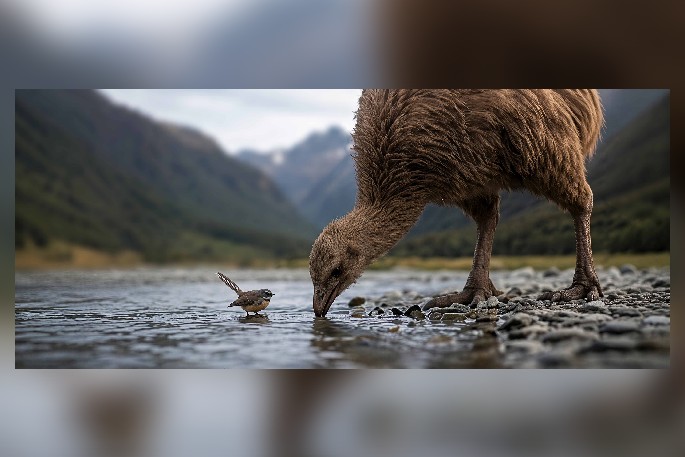
Visitors are guided by two characters: Sam, an ancient moa who has missed the last 600 years, and Samantha, a young fantail who explains what happened while he was gone.
Every ticket helps fund a native tree
Every ticket sold helps fund a native plant — at full capacity, 100,000 natives replanted in the region every year. Fifteen percent of net profit goes to an Environmental Trust and a further three percent to an Educational Trust.
“Millions of people come to New Zealand every year to experience what they believe is untouched nature. We show how just 800 years of human impact have dramatically changed this landscape. Going back in time, our visitors see that change has always been part of this planet’s story — change in itself is nothing to fear. But every year now brings new records: droughts, wildfires, floods. We know what climate change is bringing, and that means it is up to us to adapt how we live and to strengthen our resilience. State-of-the-art VR and breathtaking visuals, in a landscape like this, give every visitor a better sense of what each of us can do.” says Gerhard Sieber, co-founder and managing director, The Hillocks Holdings Limited
“As the fifth generation of my family to have lived in the Wakatipu, I have always had strong links to this piece of New Zealand. The amazing landscape that draws so many visitors to Glenorchy every year, and the local community and environmental initiatives that have been growing here for decades, make this the best place for a world-leading touchstone experience in regenerative, sustainable eco-tourism. Our guests will not only leave a tree behind, but take that hope and confidence back home.” says Jeremy Railton, co-founder and director, The Future is Wild™ @ The Hillocks
The team behind it
The VR content was produced by an international production team led by Dr Karsten Schneider of Burningfish Productions in Dunedin, with Thomas Adrian Mulder (software and VR synchronisation), Bill Morris (script and editing), Alireza Emami and Jacob Barrow (VFX and real-time development in Unreal Engine). Sam, Samantha and all the other creatures were created using traditional 3D modelling and animation workflows and industry-standard digital content creation tools, with the assets then imported into Unreal Engine for rendering. Cinematic AI was incorporated for about a quarter of the total running time, using the team’s own hand-built 3D models and photographs of the Dart Valley as source material and visual references. The AR Safari was developed by Ministry XR, based in Singapore and Kuala Lumpur. The site sits on a 24-hectare leasehold with resource consent granted in December 2024.
“The Hillocks was one of those rare projects where everything suddenly came together. We had this breathtaking landscape, fascinating stories to tell, and technologies that were finally becoming capable of bringing those stories to life in ways I had only dreamed of before. We’re no longer just showing people another world. We’re inviting them to step inside it.” Says Dr Karsten Schneider, executive producer and art director, Burningfish Productions
Day-to-day operations are led by Georgie Robertson, director of operations,The Future is Wild™ @ The Hillocks who has worked in tourism, hospitality and pest management in the region for almost 20 years. The project continues a long tradition of nature tourism at the head of the lake — from the TSS Earnslaw and the early Kinloch Lodge to today’s predator-control work by the Routeburn Dart Wildlife Trust.
“For almost twenty years, whatever tourism or environmental work I was doing, I kept being drawn back to this corner of the country – the Routeburn, the Greenstone, the Rees and Dart valleys. I love this place, and I love this project. It puts the environment and education first and wraps them in an experience that will stay with people long after they have gone home.” says Georgie.
Planning a visit
The visitor centre is at the Dart River Bridge, 404 Glenorchy-Routeburn Road, Glenorchy. Guided VR tours depart daily every 20 minutes from 10 am (last tour 4 pm) in groups of up to 15; the guided tour takes 60 to 75 minutes, and visitors should allow two to two and a half hours for the whole experience. The experience is recommended for ages 10 and up, with visitors under 16 accompanied by a participating adult. The age guidance follows the headset manufacturers’ own limits (Meta sets 10 for its Quest headsets, Sony 12 for PlayStation VR2), which reflect children’s visual development and the fit of headsets built for adult heads, and the team’s own testing: younger children can find it unsettling to lose sight of their own body once the headset is on, and in a group of up to 15 one upset child affects everyone. Younger children are welcome on the trail and the self-guided AR Safari with an accompanying adult. The main trail is easy underfoot and wheelchair accessible; the viewing & night sky platform has assisted wheelchair access only. The experience takes place partly outdoors, so visitors should dress for the Dart Valley’s weather.
Tickets: Adults (16 and older) NZ$179 · Youth (10–15) NZ$129. Available online at fiw.co.nz, through authorised tour operators and accommodation partners, and on site subject to availability; bookings can be changed or refunded up to 48 hours before the session. Accommodation partners at launch are Blanket Bay, Kinloch Wilderness Retreat and The Great Glenorchy Alpine Base Camp. Helicopter transfers from Queenstown are available with Heli Glenorchy.
Tickets and full details: fiw.co.nz