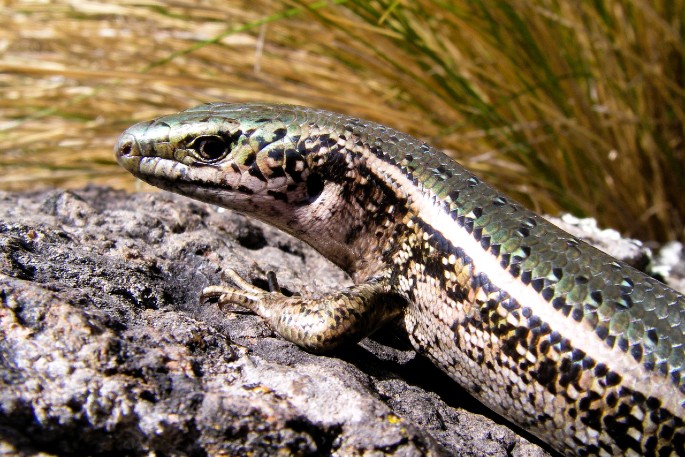
A possible new population of the nationally endangered Canterbury spotted skink has been discovered in an area where the species has not been seen for more than 50 years.
The discovery follows a photograph taken by fly-fishing guide Martin Langlands between Korowai Torlesse Tussocklands Park and Castle Hill/Kura Tāwhiti, about an hour from Christchurch.
Herpetologists identified the lizard as a Canterbury spotted skink, with researchers subsequently visiting the area and spotting three more.
Fewer than 1,000 Canterbury spotted skinks are thought to remain, and a former stronghold population at Kaitorete Spit, near Christchurch, has collapsed.
Department of Conservation senior technical advisor and lizard expert Lynn Adams says the discovery raises the possibility that more skinks remain in the area.
“We thought they were long gone from this area. The fact they have been seen up there means there may be more.”
Christchurch ecologist and herpetologist Dr Marieke Lettink says the verified sighting opens up a large area where the species could potentially be found.
“They are very distinctive, large with a beautiful green sparkle. If people are out naturing, fly fishing, walking on Banks Peninsula, the central Canterbury foothills or in the Waimakariri Basin and you see something like this, take a photo and record where you are and send it into us.”
Lynn says sightings from the public can help DOC better understand remaining populations of the rare species.
“We can’t be everywhere, but people can really help us when they’re out naturing. We don’t want to lose this large, rare and usually very secretive skink. It’s vital we know where the populations may be.”
Rare skink discovery excites DOC researchers