


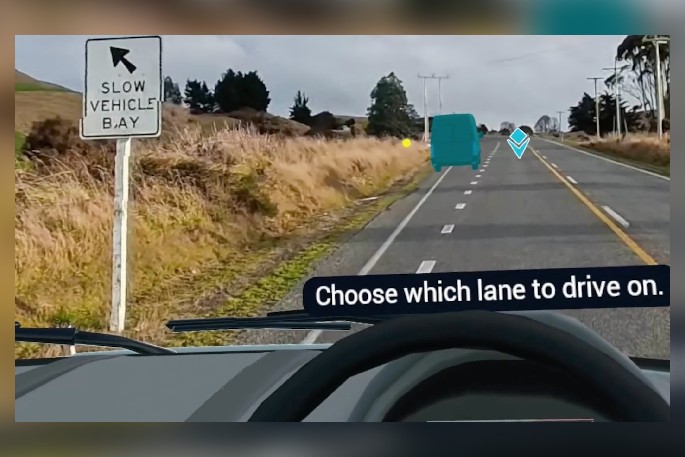
We’d rather a guest makes a mistake in a VR headset than on State Highway 6.
Before guests leave Wilderness Motorhomes’ Auckland and Christchurch base, we invite them to spend about 10 minutes practising decisions they may face on their travels. Wearing a virtual reality headset, they encounter a one-lane bridge, stock on the road or a slow vehicle ahead of a blind corner. They choose how to respond and receive immediate feedback when they get it wrong.
Our decision to introduce the programme grew out of becoming a certified B Corporation. During that process, driver safety emerged as one of our guests’ top three concerns. We wanted to do more to address it before they drove away.
We see guests arrive excited about their New Zealand adventure, but also understandably nervous. Many have never driven on the left, and most have never handled a vehicle this size. Even a careful, experienced driver has some adjusting to do when taking charge of a seven-metre motorhome on unfamiliar roads.
Of course, this isn’t the only driver safety support we provide. Our guests also receive written driver safety information – which is standard in the industry. But on top of that we also suggest detailed itineraries, provide videos on safe driving and using your motorhome before guests arrive; and route advice and tips in person during the handover process.
For our VR driver training we use CoDriVR Explore, software owned and developed by innovative New Zealand company GFactor Industries. It puts guests behind the wheel on simulated New Zealand roads. Participation is optional and included in the rental, so guests can try it at our base without charge.
The results have given us a better understanding of which situations cause difficulty.
From January to September 2026, Wilderness guests undertook 299 drives in the programme and completed 2,315 scenario attempts. They answered 89.7 per cent correctly, and 244 drives covered all nine scenarios.
Overtaking a tractor at a blind corner caused the most trouble. There were 80 incorrect responses in 247 attempts, an error rate of 32.4 per cent.
That deserves our attention. A slow vehicle can test a driver’s patience, particularly when they have somewhere they want to reach. In the headset, guests have to judge whether they can see enough of the road ahead to pass safely. If they choose poorly, they learn why while still sitting at our base.
We can’t conclude that nearly a third would make the same mistake on the road. But we can see this decision needs attention during preparation. A written warning about overtaking would not tell us whether someone understood how to apply it.
Letting faster vehicles pass was another challenge, with an error rate of 19.4 per cent. Someone driving a large vehicle on unfamiliar roads may quite reasonably travel slowly. Knowing when and how to let the traffic behind them pass is part of learning to handle that situation.
Other results were reassuring. The one-lane bridge scenario produced just one incorrect response in 244 attempts.
Guests have also told us they find the experience worthwhile. Across 226 sessions that received ratings, the average educational score was 4.71 out of five. Our base teams report guests asking to use the headset before entering their motorhome. Some have even asked whether they could take one away for a refresher during their trip.
We are tracking incidents to assess whether this preparation translates into safer driving. The simulation results and guest feedback are encouraging, but they do not yet establish a reduction in crashes.
Ten minutes cannot teach someone everything they need to know about driving here. But it gives them a chance to make a mistake, understand it and discuss it before encountering the same scenario on the open road.
The reasons to improve preparation extend beyond our guests. Local residents use these roads every day. They encounter visitors on narrow bridges and winding highways, and they sit behind them when traffic builds. They have a stake in how well we prepare people before handing over a motorhome.
I’d love to see other motorhome rental operators offer similar preparation. We all put visitors onto the same roads, and we have good reason to share what we learn about helping them drive safely.
I’d welcome a conversation with other operators about making this preparation more widely available, and sharing our experience with the programme. In time we could compare the decisions guests struggle with and the practicalities of offering the experience during handover. As we collect incident data, we should also discuss how to assess the results consistently.
Smaller operators may want to know how much staff time is involved, what equipment they need and how guests respond. Sharing our experience would help them decide whether it would work in their own depots.