

This Content Is Only For Subscribers
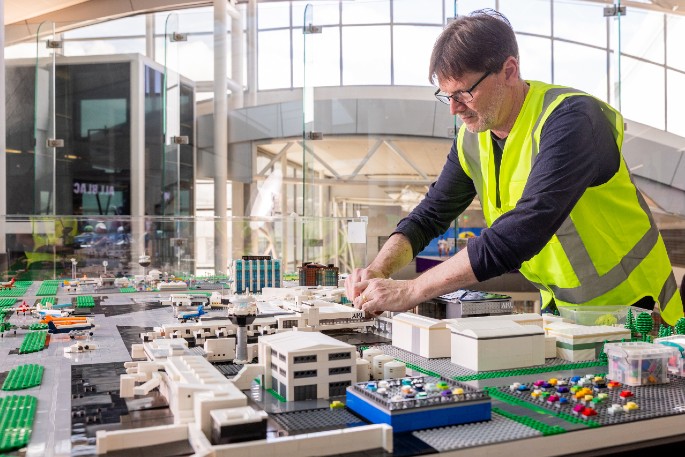
Auckland Airport has unveiled a large-scale Lego model showcasing its future terminal and the original 1960s terminal, as the airport celebrates its 60th anniversary of operations.
The custom built 3m x 1.8m Lego model went on display yesterday morning at the airport’s international terminal, highlighting how the airport has grown and evolved since it first opened its doors on January 29, 1966.
“Auckland Airport is a story of community, connection, and commerce,” says Auckland Airport chief executive Carrie Hurihanganui.
“Today Auckland Airport is one of New Zealand’s most strategic assets, the primary gateway for New Zealanders to explore the world, an essential channel for trade and tourism, and a facilitator of relationships between families and friends.
“From the very first day of operations in 1966, New Zealanders have been massively enthusiastic about the travel opportunities made possible by advances in aircraft technology. More than 200,000 Aucklanders revelled in the excitement of a three-day air pageant in January 1966 to celebrate the opening and 60 years later that passion for travel remains as strong as ever.”
Construction of the Lego model, now on display on level one of the international terminal, offers a miniature, brick-built glimpse of Auckland Airport’s infrastructure development programme – its most significant transformation since opening in 1966.
As part of the 10 year capital plan until 2032, the $5.7 billion programme is delivering an integrated international and domestic terminal with state-of-the-art check-in and baggage facilities.
“This programme spans the terminal, airfield and transport network, and is designed to strengthen capacity, resilience, efficiency, sustainability and the customer experience at New Zealand’s aviation gateway,” says Carrie. “We’re building for the future to serve the needs of travellers, airlines and the wider economy for decades to come.”
From the golden age of travel to today
In the year to December 2025 more than 2.3 million New Zealanders departed from Auckland Airport to embark on international journeys. In 1966, 700,000 travellers connected through Auckland Airport; in 2025, 18.9 million. The runway has twice been extended for 747s and A380s to land.
From original partners Air New Zealand, Qantas, and then Canadian Pacific Airlines (now Air Canada), Auckland Airport today welcomes 25 international airlines flying to 43 destinations, alongside national and regional carriers serving 23 New Zealand towns and cities.
But more than a gateway for leisure travellers, Carrie says Auckland Airport had evolved into critical infrastructure for the New Zealand economy, generating an estimated $35 billion of domestic economic activity and facilitating $31 billion of export and import trade annually.
Freight has grown from 8,300 tonnes of domestic and international cargo in 1966 to more than 169,000 tonnes of international cargo today, while more than 25,000 people now work across the precinct. Each daily international widebody service supports significant economic value and in total, flights contribute to over $6 billion in domestic tourism expenditure annually.
“The 60th anniversary is a time to honour our airline and ground handling partners, our border agency partners, the hundreds of companies and thousands of people who make the airport ecosystem hum, and especially the 750 people in the Auckland Airport team who make things flow today, and the many faces who have contributed their time to the airport over the last six decades,” says Carrie.
Auckland Airport acknowledges more than 800 years of history on this whenua, reaching back to the mid 1300s with the arrival of the Tainui Waka. Māori settled in the area, cultivated the volcanic soils and fished the surrounding waters, establishing deep connections to the land that their descendants continue today.
“I also acknowledge both central and local government, for the role they have played in the inception and development of the airport,” says Carrie.
With the arrival of aviation in the early twentieth century, Aucklanders quickly took it up, designing, testing, and flying biplanes to captivated audiences from as early as 1911 – putting the city ahead of global aviation trends, according to University of Auckland research.
By the 1930s, civic leaders were determined to build a gateway airport, considering multiple sites and the Auckland Aero Club, founded in 1928, was on farmland where Auckland Airport is now located. Public enthusiasm soared again in 1936, when 6,000 New Zealanders welcomed Jean Batten home after her record‑breaking flight from England.
Fit for future
As Auckland Airport celebrates its 60th anniversary, more than 1,500 construction workers (peaking at 2,500) are currently on site each day to advance the build of the new domestic jet terminal, integrating it into the current international terminal. The new terminal will boost traveller processing capacity by 44 per cent and add 26 per cent more capacity for domestic airline seats, with a further 10 per cent available through flexible bus‑lounge operations. For the first time, travellers will be able to step seamlessly between domestic jet services and international flights with a quick indoor walk. Recent research by Kantar shows 77 per cent of Aucklanders surveyed support the redevelopment of Auckland Airport.
To mark the anniversary, Auckland Lego builder Jon-Paul Hansen was commissioned to create a detailed miniature model of the airport, capturing both the original terminal and its future integrated terminal, reflecting the airport’s evolution over six decades. It took more than 25,000 bricks and more than 200 hours to complete.
“I remember visiting the airport as a child in the late 1970s to meet up with family, and got to play Space Invaders which was a special treat at that time,” says Jon-Paul. “Getting to make a large model of the original terminal as well as the 2029 terminal has been a fantastic project to work on, full of nostalgia, and I really hope people enjoy it.”
Over the past year, Auckland Airport’s development programme has delivered a 250,000m2 expansion of the airfield, a new cargo precinct begun its staged opening and 4.5 kilometres of new stormwater upgrades were completed, including a first-of-its-kind coupled wetland biofilter to improve water quality before its released in the Manukau Harbour. Work is about to start on a fully digital, user-focused check-in experience that will include self-service kiosks and automated bag drops.
A 2024 EY report projects the airport will move NZ$41.1 billion in freight annually by 2032, driven by continued investment in aeronautical infrastructure. Already New Zealand’s third-largest port by cargo value, Auckland Airport handled $36.1 billion in exports and imports in the year to November 2025.
“Every traveller matters – from everyday journeys to visits by royalty and rock stars. Auckland Airport is proud to serve New Zealand and help connect our country to the world,” says Carrie.