

This Content Is Only For Subscribers
The small West Coast settlement of Hari Hari will become the base for one of New Zealand’s most demanding endurance events, with the True West Adventure Race heading to the area in February.
Now in its fourth year, the True West Adventure Race has established itself as a fixture on the national adventure racing calendar, attracting teams from across the country to remote and challenging West Coast terrain.
The event will be held from Thursday, February 19, to Sunday, February 22, 2026.
With a permanent population of about 250 people, the race is expected to effectively double the number of people in Hari Hari during race week.
Race director Nathan Fa’avae says the region offers terrain that is increasingly rare on a global scale.
“There are very few places left in the world where events like this can operate across such vast, undeveloped landscapes, and the West Coast remains truly special in that regard,” Nathan says.
Each year the event moves to a different West Coast location. Previous editions have been based in Franz Josef, Hokitika and Haast, before moving to Hari Hari for 2026.
Nathan says the West Coast’s natural environment is well suited to adventure racing, from the coastline to the Southern Alps.
“Wild coastlines, powerful rivers, lakes and wetlands sit alongside dense native forests, remote valleys, glaciers and mountains, creating terrain that is varied and world class,” he says.
Cultural context is also an important part of the event.
“The West Coast is deeply embedded in Māori history, with generations travelling, living and surviving in these landscapes,” Nathan says. “Adventure racers experience a small part of that journey as they move through the land under their own power and develop a strong appreciation for place.”
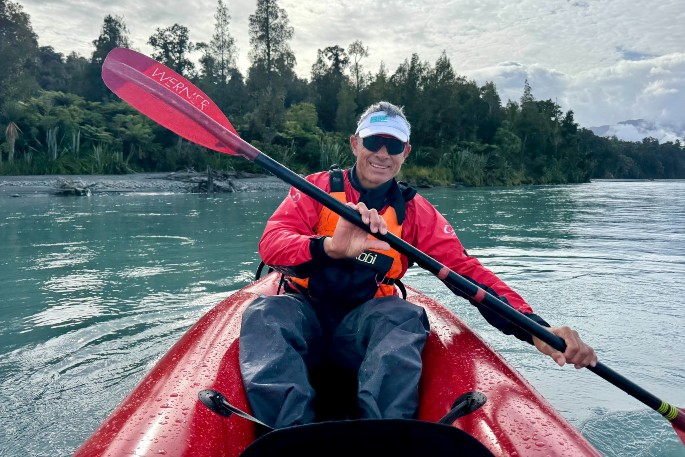
Teams of two to four competitors navigate continuously using only map and compass, travelling on foot, by mountain bike and by paddle. Depending on the race category, teams may be on the course for anything from several hours up to 48 hours.
True West includes multiple race lengths and categories, including open, veteran and schools divisions, making the event accessible to elite teams, first-time racers and young athletes. A formal schools category has been introduced for 2026.
The event has already attracted 70 teams, representing more than 200 competitors, with organisers expecting numbers to continue to grow closer to race week.
Development West Coast chief executive Heath Milne says the event is a strong fit for the region.
“Having hundreds of people based in small towns like Hari Hari provides a real boost for local businesses and helps showcase our communities alongside the landscape,” Heath says.
Westland District Council mayor Helen Lash says hosting the event will strengthen community pride and participation.
“It gives local people the chance to be involved through volunteering and supporting logistics, while highlighting the landscape and trails around Hari Hari,” Helen says.
Hari Hari Community Association secretary Judy Cardno says the town is preparing for the influx of competitors and supporters, with accommodation fully booked and the local rugby ground being used as a campground.
“The community is really looking forward to welcoming visitors to Hari Hari,” Judy says.